A Globe of Witnesses      
AGW Welcome The Witness Magazine


Flesh in Our Own Lives

Lectionary Reflections for the Fourth Sunday of Advent (A)

By Isaac Miller


Readings for Advent 4, Year A, Dec. 19, 2004

Isaiah 7:10-16
Psalm 80:1-7, 16 - 18
Romans 1:1-7
Matthew 1:18-25


In this Sunday's Gospel, we hear of the Virgin Birth and Joseph's decision, in response to a dream, “not to put her away quietly.” When considering the challenge of interpreting this story in a social justice context, my first reaction was: Yeah, sure!  

Sometimes the text does not carry the message we would rather share. Sometimes, perhaps, the text reminds us that the folk we serve have need in the faith to be sustained and encouraged in rough times, and nothing else. At this point my sense is we say, “Well, Jesus, if that's where you'd have me go, I'm there, but . . .” In other words, preaching is a dialogue with a people based on a series of dialogues – ours and our people's – with God. These reflections then are written in that space before preaching begins – a space of wrestling with God, the Spirit and the text.

Back in seminary, we were told that the whole of the Gospel was written in the light of the Cross/resurrection perspective. From this perspective, a life that culminates as Jesus' did cannot have begun like ours. The early church is saying that if his death – and rising to life again – has such power for new life and new community, then his birth and the circumstances surrounding it must have been similar. Once this position is taken, again from this looking back perspective, you have to figure out what to do with Joseph, the father of Jesus' siblings. This is probably a fairly typically “critical” – and, in its own way, literalistic – reading of this passage.

On another level, this passage and the crucifixion/resurrection portions of the Gospel are a means by which “God is given the Glory”: Glory to God for Good Friday/Easter and Glory to God for the incarnation/birth. The early church and we understand quite correctly that without the manger, the Cross, and the empty tomb, the hope for our lives – all life and the whole of history – would be lost.

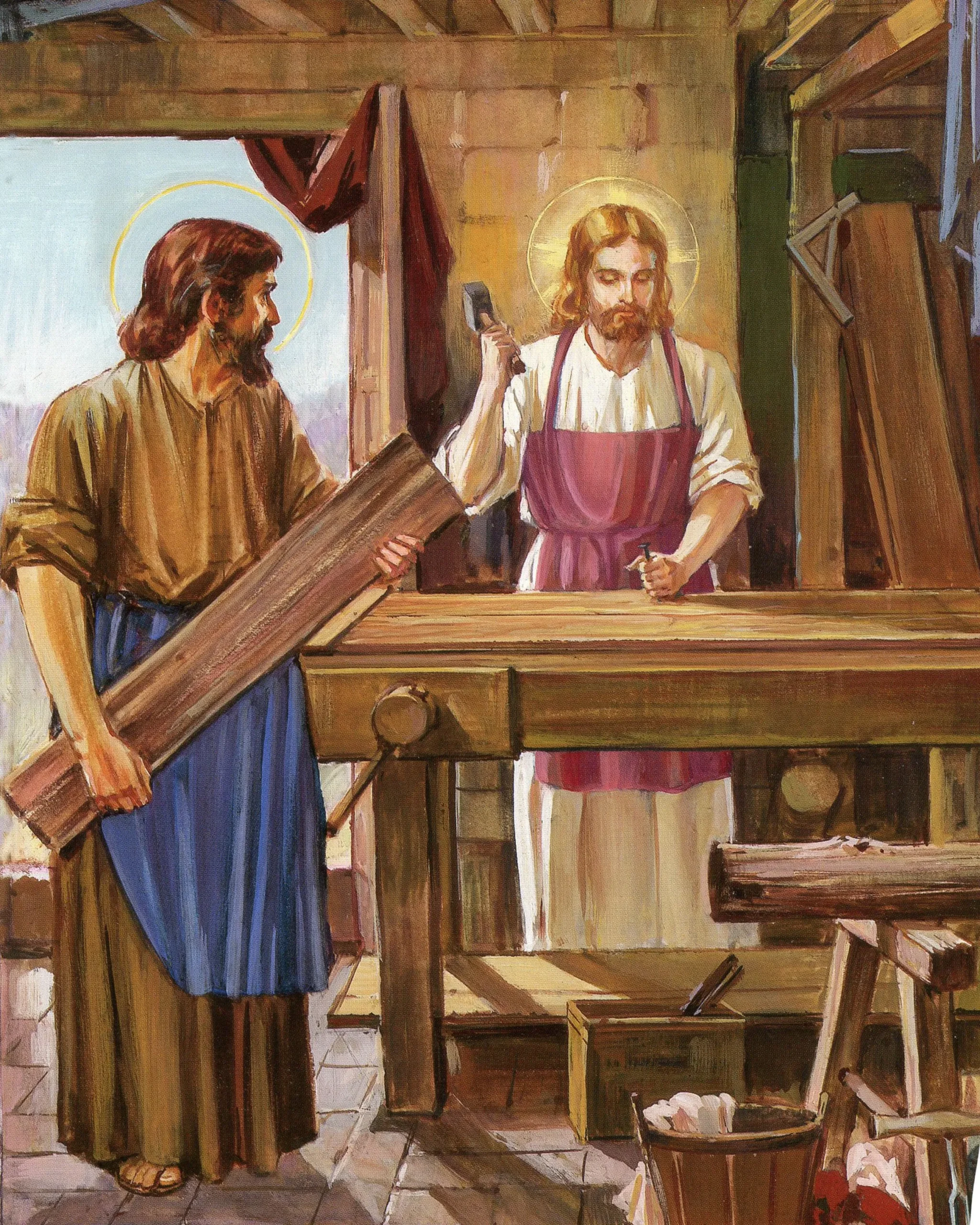
[T]here is a challenge, a challenge that may go to the heart of the biblical call to justice. . . Whether we go for the Virgin Birth or not, Jesus had a family, and that family, those parents had to say yes to their roles in nurturing, changing diapers, instructing, and sharing God's love in loving him.

Finally, if this vein of thought holds any water, there is a challenge, a challenge that may go to the heart of the biblical call to justice. Very simply, somebody's got to say “yes” to God if the work of salvation/liberation is to begin. Bluntly, the tradition says Mary consented (poetically, in the Magnificat), she was not raped; Joseph, likewise, did not hang in as Jesus' (earthly) father with a pistol at his head. Whether we go for the Virgin Birth or not, Jesus had a family, and that family, those parents had to say yes to their roles in nurturing, changing diapers, instructing, and sharing God's love in loving him.

It really does not matter whether Mary – from whose circles of veneration in the early church the Virgin Birth stems in part – foresaw and pondered so much about her firstborn or not. It doesn't matter what Joseph's role was in the whole process either (or for how long he played it, since at some point it seems he disappears): both he and Mary had to say “yes”, even if they did not know the specifics of what they said yes to.

In all of the above there is nothing particularly new or hard hitting social justice-wise. But the “yes” that the text seeks is really quite remarkable. It is a yes to God's power, God's love working in us. It is God seeking our consent, as Joseph's and Mary's had been sought for the sake of the kingdom, the reign of God's love. It is perhaps a yes that God seeks because without our consent, God is powerless, and Advent is nothing more than “getting ready” for Christmas.

[W]ithout our consent, God is powerless, and Advent is nothing more than “getting ready” for Christmas.

I believe we hear a quiet request in the Spirit that we allow the work of Christ to become flesh in our own lives. It feels like a longing on God's part for us as God's people, as we approach Christmas. It is an appropriate longing for us to be ready (somehow Sam Cooke's “A Change is Gonna Come” and the Chambers Brothers' “People Get Ready” cross my mind here) from within, from the quiet place where Grace allows to say yes to the hard work of seeking justice without knowing the specifics.

It seems to me – recalling the readings from Isaiah in Advent that speak of the Gentiles, the nations, the whole of the universe's longing for and response to God's action – that it is a “yes” that God ardently seeks from all humankind. If God's love is fulfilled in God's kingdom vision, then clearly, at least as I see the Spirit's movement here, God is not checking the credentials of those who would follow Mary and Joseph's lead.

Somehow this allows the penitential aspects of Advent to shine clear and opens the door to solidarity that is truly catholic and hope-filled. Penitential because our lack of response, our sense that God's call and invitation is to certain folk to the exclusion of others, causes hurt to God. Truly catholic and hope-filled because, as we recognize that God's call is to all, we realize – in spite of last month's electoral debacle – that the vast majority of humanity stands with us as we stand with him who identified himself as one of   “the least of these.” This penitential business, which some how is related to our taking up the Cross and following him, is important in this season of imperial militarism in Iraq – it is a reminder that it is God's reign that we are promised, called to work for and witness to and not our own: if we could get this right the whole world would breathe a sigh of relief!


The Rev. Isaac J. Miller is rector of Church of the Advocate in Philadelphia, Penn, an Episcopal congregation with deep social justice and community organizing roots. He is co-chair of Philadelphia Interfaith Action (PIA), an Industrial Areas Foundation (IAF) network organization. “If you are in Philly, visit,” Isaac urges, and he may be reached by email at rmill7@aol.com .